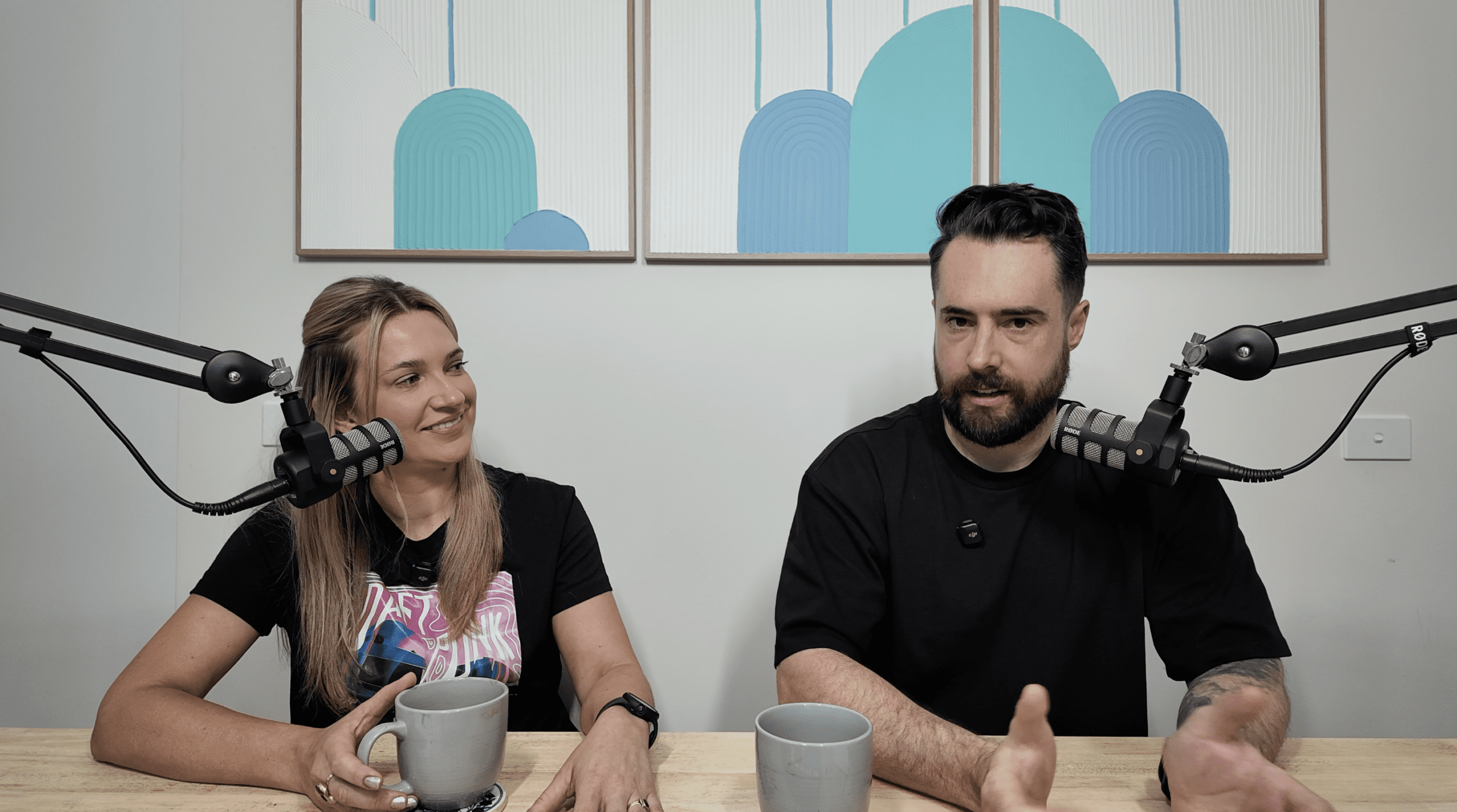

Aleks: Your wedding should feel like the best version of you, not a performance and definitely not a chore. I’m Aleks.
Eddy: And I’m Eddy. Welcome back to Project Engaged.
Aleks: We’re both celebrants, DJs, and MCs who believe that when you throw out the wedding rule book, you’re left with a day that’s actually fun, authentic, and completely true to who you are.
Eddy: This season, we’re sharing the secrets to a celebration that flows naturally, keeps your guests happy, and stays focused on what matters.
Aleks: No fluff, no pressure, just great advice for a great party.
Eddy: Let’s do it. Welcome back to Project Engaged.
Aleks: That was very formal.
Eddy: Yeah, it really was.
Aleks: And you do look like a newsreader. You’re like clasping your hands. Yeah, you got the papers. All we need is like a pretend keyboard. You know, at the end of the when they read the news, they like and good evening. And they like pretend to type.
Eddy: Yeah, sure. I just go on my phone.
Aleks: Just go on your phone and be like scrolling. Anyway, welcome back on on another episode to another episode. Sorry, archive something important.
Eddy: Okay. Yeah. Don’t do that. Uh we are talking about not the most exciting topic, but so bloody important.
Aleks: What do you mean not the most exciting? I’m very excited about this topic.
Eddy: I know you are. You’re
Aleks: I’m passionate about this topic.
Eddy: Yes, that’s fair. All right, that’s fair. We’re talking about volume control at events.
Aleks: So, basically weddings.
Eddy: Yeah. So, we’re basically talking about navigating sound restrictions. And the reason I say it’s not exciting is because I think people don’t want to think about it. And I think that’s part of the problem, but we’ll get into that. But it is something super super important for couples to think about um definitely when they’re booking a venue.
Aleks: Well, yeah.
Eddy: And after and to ask questions about when they’re in the process of booking their venue because a lot of the time venues tend not to talk too much about it, which I completely understand. You know, they’re you’re looking at the venue, looking at the aesthetics of the venue, the flow, the spaces. Uh and oftentimes these things get buried in in contracts. So, the sound restriction levels and things like that, which you’ll find out about a bit later on. Um, and it’s a little bit too late then.
Aleks: It is, but there’s some things you can do to mitigate.
Eddy: Oh, yes. And that’s what we’re talking about.
Aleks: And that’s what we’ll talk about. So, it’s not all bad news, but
Eddy: Oh, it’s really not.
Aleks: But we will explain a little bit more because I think part of the problem is it is can be quite technical, especially if it’s buried in a contract somewhere in your terms. So, and you’re the expert on this. You can explain it far better than me. Where should we start?
Eddy: Well, I I wanted to talk about things buried in a contract just for one second before we get into the the meat of this episode. Um, you can throw the contract into ChatGPT these days. Um, with a pinch of salt, obviously, you can’t get everything right all the time. Um, and just ask questions about sound and whether there’s any restrictions or or any anything like that. So, there are ways to, I suppose, quickly and easily find out about these early questions that um perhaps you you know you might not want to ask because if you’ve already booked the venue.
Aleks: Yeah. And look I think that the reason that we want to talk about this topic is because the reality is that especially since COVID after lockdowns we are seeing more and more restrictions at venues that we’ve worked at a lot that have never had an issue purely because you know you had very very quiet periods of no events.
Eddy: Well that was always my theory.
Aleks: Um that was always my theory and look and it’s not it’s not the venue that’s doing it. It’s usually one or two, let’s say, grumpy neighbours, I suppose, that that that are really calling the shots. Um, calling the council, getting the council around to do sound checks and forcing forcing these restrictions on venues. So, it it’s a hard position to be in for all parties, I think.
Eddy: Oh, absolutely. And I really feel for the venues, especially when, you know, you’re a venue that’s really well established and you’ve been around for a while and you’ve done lots of weddings and events and you’ve got a nice reputation and then suddenly a developer puts up a block of apartments next door
Aleks: has happened.
Eddy: It does happen all the time and that is, you know, in high-density areas that’s what happens. So that’s something to consider when you’re looking at a venue as well. But yeah, it’s not all bad news and there’s lots of things that venues can do. There’s lots of things that you as the couple can do and obviously there’s lots of things that your DJ or chosen entertainer can do as well.
Aleks: Yes, absolutely. Well, let’s uh let’s dig in, shall we?
Eddy: Yeah. So, let’s talk about But I think maybe you can explain a little bit in terms of what the sound restrictions might look at the different types of sound restrictions and what it kind of means in a very simple way because it can seem very scary and technical and jargony.
Aleks: Yeah. Yeah.
Eddy: Layperson.
Aleks: There are sort of three main I think points to to to tackle. Um so that’s uh EPA limits. So EPA is environment protection authority or something like that. Is that right?
Eddy: Yeah, something like that. about
Aleks: I legitimately don’t know. Um, so that’s why I was asking you, but EPA and you’ll find that um, venues talk about EPA when it when you’re out at sort of the Yarra Valley in more sort of regional-esque venues uh, further out of the CBD and further out of the inner city. So they have sort of strict limits around the boundaries of venues um, where the sound can’t exceed a certain uh, dB decibel level and that’s the technical term um, that a lot of venues will talk about dB levels. And understandably if you’ve never heard of that before and they’re saying, “Oh, I can’t reach this dB.” Well, what does that even what does that even mean? And we’ll get to how to start to understand that as well.
Eddy: Yeah.
Aleks: So, you you’ve got your EPA limits outside of the the city. Uh we’ve mentioned neighbours. Obviously, neighbours come up a lot.
Eddy: Um high-density residential areas with venues, you know, so you’re talking like your Collingwood venues and your South Melbourne and anywhere where there’s a quite a big uh populace uh of apartments and and and houses and things like that. Uh, so that’s that’s another one. Neighbours, they can get pretty cranky. Um, and like I said, usually one or two. It’s usually just one to be honest with you.
Aleks: Like honestly, can I just make just a side note? What the hell are you doing living on Smith Street if you’re going to complain about sound? Like you are in the thick of it. It is a party street.
Eddy: Yeah, arguing with someone that is in that situation is pretty much pointless. And uh I can understand from their perspective, but I can also understand from the small business that is the venue’s perspective that they probably been there longer than that person has in most cases. So, yeah. So, that’s that’s a really tricky one, particularly if um they’re in the same building as the venue. The venue might be on a certain floor or down the bottom and you’ve got apartments that are above that. Um so, again, uh you know, that that’s a tough one.
Aleks: Well, I think I think the I think the point to make there is that um depending on how well the sound travels within a particular venue will determine what sort of limits the venue put. Yeah, that makes sense. So, for example, if you know, you’ve got double glaze, triple glaze windows, if you’ve got some sort of ceiling installation or I mean there’s bu you know, there’s there’s certain codes you have to follow in terms of soundproofing um you know, a building like a ceiling for example. So, if that’s not in place as well, that’s going to mean that you’re probably going to have to have stricter limits because those measures aren’t in place in the building itself, in the walls, in the in the ceiling, in the floors, in the windows, etc. So, I think that’s going to affect how much the venue needs to restrict the sound and what volume it needs to be at.
Eddy: Yeah, absolutely.
Aleks: So, older building, maybe the venue hasn’t had the funds or the time or the energy to put because you can put things in in in place. You can, you know, take measures and be able to increase the volume as a venue, but that doesn’t mean that every venue is in a position to be able to do so
Eddy: or they might not have permission to do so because it might be a heritage listed building or something.
Aleks: So, there’s lots of considerations. Yeah. In terms of soundproofing.
Eddy: Yeah. So there, so there some of the reasons why obviously the rules exist. Um, and it’s look, particularly the first two, the EPA stuff and the neighbours. They’ll come up quite a bit. They’re the ones that we get the most.
Aleks: Yeah. Yeah. Because it makes sense. So the neighbours is, you know, more of an issue in like metro venues and then the EPA stuff is more of an issue as you said, more regional venues. Um, you know, we have lots of kangaroos. All I can think about when I think about EPA is The Simpsons Movie. Do you remember The Simpsons movie?
Eddy: I don’t actually remember.
Aleks: EPA EPA EPA. Anyway, maybe I’m completely hallucinating that. Um, yes. Oh, you’re looking it up now.
Eddy: Yeah, I am.
Aleks: Okay. So, I just made up an acronym potentially.
Eddy: No, I think Yeah. Yeah. The Environmental Protection Agency. That’s the one.
Aleks: What did I say? Environmental Protection Authority Authority.
Eddy: So, look, obviously, why should why should you care? Well, I assume you’re listening to this podcast because you want your wedding to be a fun party. And if your music is at background levels, that’s going to be difficult to achieve. So that’s why I suppose it makes sense. If you don’t care that much, you’re probably not listening to this podcast and it won’t matter to you.
Aleks: Yeah. Exactly.
Eddy: It won’t affect you.
Aleks: Exactly. Exactly. So, and look, there are there are some venues that um we just won’t if we get an enquire, we just we just will politely say we’re we’re unable to play this venue due to the fact that their sound restrictions are incredibly um
Eddy: harsh.
Aleks: Harsh because we just can’t do our jobs. ly unfortunately and we’re not doing right by our couples and we’re not doing right by their guests. Um and we’re not really doing right by ourselves cuz it’s very very difficult to and we’ve both been there. Um and I’m sure that you’re thinking of pretty much the same venues that I’m thinking about right now. It’s incredibly difficult uh to to manage guests continually coming up to you asking you to turn it up. I’ve had instances where there have been people walking around with uh dB meters so decibel monitors that will monitor how quote unquote loud everything is um in in my face. This is too loud and you just Yeah, it just makes your job almost impossible to do.
Eddy: It’s soul-crushing.
Aleks: It’s soul-crushing
Eddy: especially when you know the couple wanted such a huge party and their music brief has a lot of bassy music, dance music, R&B and hip-hop. It’s just painful.
Aleks: Yeah.
Eddy: So, we want to we want to try and avoid that. But, um it’s not all doom and gloom. There are some things that that you can do obviously um but we we will get into that
Aleks: and and different venues and you know we obviously try and push it as far as we can. Different venues have different tolerance levels depending on what their situation is whether they’re like you know five complaints in for the neighbour and literally at the um threat threat of being shut down which is which is the reality for some venues.
Eddy: Oh yeah.
Aleks: Um or whether they’ve only had you know one or two complaints and it’s it’s not actually that bad. So there are yeah there are different levels of tolerance from the venues as well.
Eddy: Absolutely. Okay. So, how do you control this? What what are some of the things that that you can do in order to to to help to help you achieve that that party vibe that you want even if you are suffering some of the restrictions that have enforced on you, particularly the ones that you perhaps don’t know about when you when you’ve booked. I’ll tell you one thing, the worst sound in a wedding isn’t particularly a song that you might not be a huge fan of that you might just sneak to the bathroom for for a couple couple of minutes. The worst sound is uh the power cutting out in complete silence. Um now there this is probably my least favourite form of control in relation to sound restrictions and that is a a sound limiter, what we call a sound limiter and basically what it does it just knows when something’s a bit too loud. It will give you a grace period of a few seconds and then the power will cut out basically. And the way it’s represented usually is visually. So um there might be a a limiter that that goes uh green for yep, you’re in a good uh you’re in a good volume right now. Then it hits yellow. It’s like, oh, watch, you better watch this a little bit. You’re going up there, but you’re still safe. And then pushes on to red. And we see this and we can see it at the corner of our eye in some venues. And it’s really distracting. Um cuz you’re looking at that rather than what you’re supposed to be doing is looking at the crowd, obviously. Um when it hits red, it might be 5 seconds, 10 seconds. Uh and if you’re in that uh zone for for long enough, uh the power will cut to uh to your DJ equipment. So, that’s I’ve been there. I’ve been there once is a long time ago. Power cut for me and it comes back on and the party continues. But, um I wasn’t explained uh about the sound limited. I didn’t really even know that there was one uh there, which is another whole issue.
Aleks: What a lovely surprise for you to encounter.
Eddy: And everyone just stops, looks at you, thinks it’s your fault, of course. Uh and it can be damaging to your equipment as well. So, there’s a certain controller that I use that if the power cuts out for any reason, um I need to sort of do a full reboot and that that means it’s I’ve got to play something from another device and then go back onto it’s just it’s a stress-inducing. Yeah, it’s frustrating situation to be in. So that’s the yeah that’s the sound limiter. So there’s different types of sound limiters but yeah the visual ones work mainly like that.
Aleks: I would say that’s probably the most extreme the one that actually cuts the power because there are other venues that have sound limiters where they do give you that traffic-light like system. So green you’re okay. Um the yellow yeah you’re getting close once you’re in the red that’s it. The venue will watch it and will let you know, hey, you know, you’ve got to turn it down or turn the bass down or whatever when it gets to the red, but the one that cuts the power is brutal. And yeah, not to mention the damage to equipment. Um, yeah, not cool. But obviously, let’s maybe chat about you haven’t booked your venue or you’re looking at multiple venues, like what are some of the questions that you should be asking so that you can get on the front foot before you’ve even booked? Let’s start with you haven’t booked your venue in yet.
Eddy: Yeah, exactly. And this is all part of, you know, how to how to be in the driver’s seat, how to actually control and how
Aleks: as a as a team, venue, DJ,
Eddy: couple, how they can control and how they can manage uh not only their expectations, but manage, you know, the the the sound on the night to a point where everyone’s pretty happy. Yeah,
Aleks: cuz everyone does need to be happy. You don’t want the venue running up to the DJ every 5 minutes to turn it down. No, because you can see that happening and that’s not cool. Um Yeah. So, in the Yeah, in the stage that you are enquiring, um you’ve you’ve got so much going on. Obviously, you you be chatting to a venue, you probably got your eyes open to different vendors as well. So, there’s so much information coming in. And the sound, honestly, is probably the the last thing you’re thinking about really. You you would have seen um on social media a bunch of videos from the venue with with with DJs and bands and all that kind of stuff. So, you and you’re excited, too. You love the venue. They’re for a reason. You really want you really want to book this venue. Um and you’re talking food, you’re talking logistics, you everything. So, I’m not surprised that sound is often overlooked
Eddy: and sound is it’s it’s not the most exciting thing to talk about either really. Um,
Aleks: it’s not. But how important is it?
Eddy: It’s super important. Yes. So, so to answer your question, uh, what can you do? You got to at least raise it. Raise it as early as you can. Raise it before you know you you you’ve signed that contract with the venue because it is really important. Ask around. Ask, you know, if If you are reaching out to to DJs, musicians uh around the same time that you’re locking in your venue, ask them too. They’ll know more than anyone,
Aleks: by the way. And it doesn’t matter that you haven’t locked that person in. We are more than happy. And I’m sure a lot of DJs and bands are more than happy to answer your question.
Eddy: Well, it’s in their best interest because if it’s a venue that they are uncomfortable to play based on sound, they’re going to tell you pretty quickly that it’s probably not for them. Um and to seek, you know, um seek other other professionals to to to work with you on that
Aleks: or a different venue.
Eddy: Yeah. I mean, yeah, exactly. Yeah. It’s it’s it’s harder to say that because you might be in love with this venue for many different reasons and you know,
Aleks: I know look, it’s hard when you set your when you’ve got your mind set or sorry, your heart set on a venue because you know that you’ve been dreaming about for a while and you find out there are sound restrictions. There are a couple of things. So, yeah, definitely get on the front foot. Do you have sound restrictions? First of all,
Eddy: do you have sound restrictions? Uh, if the answer is yes, okay. Uh, what do they look like?
Aleks: Yeah. A lot of venues, a lot of venues sort of uh the ones, okay, so the ones that we we particularly don’t uh don’t generally play due to to sound, they’ll hide behind uh the dB limit. It’s like, okay, this venue, it’s got an 85 dB limit for dance floor.
Eddy: What does that mean?
Aleks: If you’re not if you’re not from that world, if you’re not technical in that way, it means nothing. And there’s so many factors that go into it as well. Um the sound changes as more people enter a room because the bodies absorb it. The sound changes if a venue is uh you know, has high ceilings. there’s a lot of wood um or if there’s glass everywhere because the sound bounces and there’s nothing to absorb it if any has carpet anywhere it sound absorbs into the there’s so many factors it’s it’s quite fascinating how sound works in light as well but it’s um it’s not unless you’re technical in in that way it’s a dB 85 it’s not going to mean anything so the biggest thing for me is to recommend all right cool so you’ve got sound restrictions I understand that 85 okay what does that sound like So, go in, book a specific time with a venue to go in there and they put their system up to 85.
Eddy: We’re talking about now a venue that has an in-house sound system because there are venues that have limits
Aleks: but don’t provide a sound system.
Eddy: Yeah, that’s right.
Aleks: But still expect the DJ to stick to a sound system. So, in your in your experience and your opinion, is it better that a venue has, you know, an a dB limit but it’s through their sound system or I know the answer to this based on experience or Or is it better to book a venue where they still do have those limits, however, the DJ or band is permitted to bring in their own stuff?
Eddy: Well, obviously the answer to that question is get the DJ to bring in their equipment um
Aleks: if possible.
Eddy: If possible. A lot of venues uh won’t allow that obviously. So, um you’re stuck with their system and they’re not all bad. Sometimes they’re okay sometimes maybe
Aleks: 25% of them. Um
Eddy: but I think Look, is it’s infinitely more difficult uh to do a sound check in a venue when they don’t have their own system.
Aleks: That’s what I mean. Yeah.
Eddy: But the reason why I’ve sort of went straight there is most of the time the venues with the most uh full-on sound restrictions do have their own system.
Aleks: So, if they have their own system, definitely ask for a sound check at the level first of all at the level of of background vibes.
Eddy: Yes.
Aleks: Right. Yep.
Eddy: And then the level of dance floor because then you can see that difference. And it’s not going to sound exactly the same when you got 80 or 100 or whatever people in that room.
Aleks: But it’s not just about and this is why it’s important to listen to the venue sound system, it’s not just about the actual volume. It’s about the clarity and the quality of the speakers. So, the way that a lot of these in-house sound systems like their speakers are configured remove the bass either remove the bass sound quite muddy. There’s no clarity there. Yeah. So, you’re better off having very clear sounds where you can hear every component of a song.
Eddy: Yeah.
Aleks: Right. from a really good quality speaker from your DJ than a louder muddy sound from a sound system. So that’s really important as well.
Eddy: Yeah, that’s really And look that also goes to um the MC’s microphone as well. Um so I will try where I can to always bring in a system even if the venue has their own system just for if nothing else the MC because I find that um their systems can be unreliable at times. Um, and again sound quite quite muddy. So,
Aleks: yeah,
Eddy: you know, and are you going to ask the DJ, oh, what system do you use and go and do your research on that system? Probably not. Like, do you really want to do that? Probably not. Um, but the DJs that that do have great systems will often say that on their uh on their marketing, you know, state-of-the-art or really high-end professional systems, there are certain brands, if you’re really interested, that we can we can let you know about that that are really really good. Uh we certainly spend the money where we need to in our systems. Uh we will also put up uh speakers in other parts of the venue as well. Um and and send signals wirelessly through to those to to kind of light up certain areas soundwise uh in in different places. Um yeah, we call them satellite speakers. So there’s that as well. But I think um to to your point, I I think you’ve really got to have what might seem to be difficult conversations early on and be realistic about what the venue can offer in terms of sound. And again, talk talk to DJs. Um, the best-case scenario is a DJ bringing their own equipment and, you know, dealing with the restrictions themselves cuz they’ve got full control. And that’s another thing. So, if you’re dealing with a venue sound system, it’s preset without, you know, without a lot of bass, without a lot of uh sort of bells and whistles. And as the as the DJ or or musicians a little bit different because, you know, if it’s an acoustic musician, they generally bring in their equipment and they’re quite loud most of the time anyway. That’s a whole other thing. We won’t venture into that territory. Um uh but yeah, if the DJs bring in their own equipment, they’ve got so much more control. And look, and if they’re professional, they’re going to work with the venue and and make sure that they’re not stepping on toes there, but their system should be good enough and have that clarity as you mentioned in order to satisfy everyone else. Because like you said, it doesn’t have to be blaringly loud. If it’s a good system, you know, the systems that are great these days are the ones that uh basically spreads sound throughout the room like really really nicely and you can often have a conversation at this sort of level in front of a speaker for dance floor which is crazy. The technology has gone so good lately um that you can kind of do that and everyone’s happy and it’s about massaging the needs of the venue, massaging the needs of of the couple
Aleks: and keeping every everybody happy which again it can be difficult. I just want to jump back to your point about you know whether a DJ has good sound equipment. I mean, most of the DJs that we know that are at and I think at a similar price point. So, p I think that’s if you’re looking at your budget for entertainment, the quality of the equipment will be reflected in the price most of the time, I would say. So, that’s something to look at as well. Um, most, you know, higher end or mid mid-range DJs will have professional, you know, really high quality sound systems and will also have options for, you mentioned putting in an extra speaker. So, we will often put in a third speaker in a long space. Firstly, for the purpose of we don’t have to crank our main two speakers in our setup. So, we’re not blasting anyone’s head off or, you know, tripping the meter or whatever by having to crank it so loud because there are people at the other end of the room who won’t be able to hear the speeches or hear the music at all during dinner or whatever it is. So, there’s different options that DJs that perhaps cost a little bit more have for you to make sure that you can deal with these sorts of Yeah,
Eddy: issues.
Aleks: Absolutely. But yeah, clarity of sound. So yeah, if you are looking at a venue sound system, have a listen not only for the volume, but to sound to hear how the speakers actually sound as well.
Eddy: Yeah, you can really go down the rabbit hole. And look, probably tell I’m pretty passionate about this stuff. And um it’s, you know, you’ve you’ve spent so much money on your day that the last thing you want is to be blindsided by restrictions that you just don’t know about. Um and again, we mentioned it before, but a really cool idea these days is to throw the contract straight into uh ChatGPT, Gemini, whatever AI chatbot you use. NotebookLM is really really good as well. Um for those who want to jump on that. So Google,
Aleks: go Google.
Eddy: Go Google.
Aleks: Google is going to be sponsoring our podcast soon.
Eddy: Um and you can ask specific questions based off and obviously, you know, double check everything um because sometimes they, you know, they get things wrong. But it’s a really quick and easy way to to answer qu you know harder questions like that and to venues that are just burying them in in their I know they have to have it in their contract, but if it is something that you know is is you know you meet with a client and they really want a big party like please mention please mention the sound. I know you want to win that win the client but just mention it because it’s it’s really important.
Aleks: I think we should um maybe just go over some like specific questions that you should ask your venue in relation to that as well and then maybe some strategies if you do have sound restrictions because we’ve sort of talked about what you should ask your venue before you book it. Okay. But say for example, you’ve booked your venue and you find out there’s sound restrictions like what can you do? What are some of the strategies
Eddy: that we would do? I might throw in a couple ideas.
Aleks: Yeah.
Eddy: Um so you mentioned, you know, about our equipment. So if we’re able to bring in our equipment, there’s a couple of things. So the speakers that we have actually allow us to reduce the bass level. So a lot of the time with the dB limits, particularly if you’re looking at like the regional venues, if you go outside of the venue, It’s the bass that will, you know, send you over that limit in terms of volume, like in terms of the decibel limit, would you say?
Aleks: I would. Yeah. Yeah.
Eddy: So there, so by turning the bass down a few decibels, which we can do on our types of speakers, which have a little subwoofer.
Aleks: Well, we’ve got full EQ, so we can we can
Eddy: people don’t know what EQ means.
Aleks: Augment the mids. That’s what I’m explaining. The mids, uh, the highs and and obviously the low the low end, which is what Aleks said, the bass. Um, but think of it of, you know, if you are, um, you know, uh anywhere and and there’s a party going on or a festival, you usually hear that thumping of the bass.
Eddy: Yeah.
Aleks: You know, so that’s and that’s what it tends to carry.
Eddy: Yeah, definitely. The other thing um is and you mentioned this earlier is if if the DJ is required to plug into the venue sound system, is there any flexibility for the DJ to bring in one small foldback or monitor speaker? So, you would have seen if you go to a bar or a club, um you know, the DJ’s like playing on the on the club or the venue’s decks and is plugged into the system, sound system. But we’ll often have like a speaker wedged right next to them so they can hear the sound as well so they can kind of monitor things.
Aleks: That is one way of getting around those stricter sound restrictions. And in my experience, I would say about 60% of the time the venue is okay for a DJ to bring a
Eddy: and the other 40% of the time it is a no.
Aleks: They don’t know it’s there. No.
Eddy: Or they don’t know it’s there. We hide our booth. We’re going to be like blacklisted from venues. But I I it has saved me so many times I can’t even tell you. And
Aleks: what it does is it does provide particularly for dance floor.
Eddy: So when it comes to dancing time, people are obviously going to be dancing closer to where the DJ is. That’s where the most of the action will be happening. If you got that little speaker right right there, just enhancing the sound system from the venue, adding a little bit more bass, adding a little bit more volume, that could save the dance floor.
Aleks: Yeah, definitely. We’ve all been there. Yeah, we’ve all been there.
Eddy: So that’s a Good question to ask as well. Okay, we’ve got sound restrictions. No worries. Can the DJ bring in
Aleks: bring in?
Eddy: Yeah.
Aleks: Yeah.
Eddy: Um that’s something that a most DJs will ask anyway.
Aleks: Yeah. Exactly. Another thing you can do is just just, you know, uh if you’ve booked your DJ or even if you haven’t, a lot of DJs are more than happy to help. Um just hook the venue up with a DJ to have that conversation.
Eddy: Yeah.
Aleks: As well, because the DJ can talk on u I suppose a different level. Um um and they’re a little bit more technical and all that kind of stuff. Uh and sort of report back and it might not be as bad as you think, you know. Some DJs might be like, “Oh, no, no, that’s fine. We, you know, I know the venue well. I’ve got a great relationship with them. I understand. I’ve been there and I understand that um there are restrictions, but they’re perhaps not as not as bad as what the venue you’re making out or or whatever it is.” So, and they’ll, you know, they’ll help you manage it in the leadup. They they’ll be there on the day to make sure that everyone’s having a good time.
Eddy: Yeah, definitely. And the other thing, final kind of thing I would say, and this has also saved us, and um that’s in relation to obviously speeches and announcements. So, you want your speeches to be heard. It’s pretty important. Um, and I think a lot of people worry about that aspect of it. If you are worried, it is worthwhile mentioning to your DJ or asking them whether they can bring an additional speaker just for speeches. So, plugging a microphone into um a smaller speaker that you know, maybe if it’s a sit down um wedding, usually for sit down to be honest, that sits halfway down. So, it kind of like hits more people rather than having it down one end and just having speeches just run through that speaker. It helps so much.
Aleks: I think you’ll find that um particularly with a venue that has uh suspect system. The venue staff usually pretty happy for that because it’s one less thing that happen to manage the microphone. Um which they were, oh, thank God you’ve got your you got your own uh microphone. I had the same I won’t mention the venue, but like I had the same thing happen to me uh last weekend. Um their microphone was a bit iffy uh in the venue for for the ceremony uh for reception. I had the mic running through my own system and they was just super relieved that that I was I was managing the mic cuz they’re running around doing so many things. I completely understand and that’s one less thing they have to worry about like tinkering with the volume and all that kind of stuff and I’ve got full control so and you know I’m a professional and it’s it’s easier for me easier for them.
Eddy: Yeah, I I would rather manage it to be honest. Um the other thing is as well like timing wise so there’s always this weird little glitch I would say in like the run sheet where couples maybe aren’t aware of the fact that the music say their event finishes their wedding finishes at 11:30 the music actually sometimes needs to be turned down by 11:00 depending on where the area is, depending on like what time your bar’s closing, what time staff are there until. There’s always this weird like half an hour is a long time when it comes to dance floor. You know what I mean? Like if you’re suddenly in a position where there’s you’re missing half an hour from your dance floor. That that that’s a big that can make a big impact. Um so I think it’s worth having the conversation. Okay, so we finish at 11:30. What time can we play dance floor level music until that very time. What time does a DJ need to finish because you might want to extend by a little bit or they might have restrictions and they might have to have everything turned down right before 11.
Aleks: Um, and there’s things you can do around that. You know, sometimes having that little wind down, that last half hour is not the end of the world. And it’s actually nice and gives people an opportunity to say goodbye and gives you as a couple an opportunity to say goodbye to people if there’s no afterparty, etc. But I think that is worth having a conversation early on as well when you’re looking at the run sheet.
Eddy: Yeah, absolutely. I think that’s Very well said. So, I think we’ve covered quite a bit in such a short amount of time actually on this and you know, I could I could talk for hours on on sound. Um, it’s probably not the most exciting thing uh to to keep banging on about, but it’s super important.
Aleks: Super important. Be upfront. You know, if you haven’t checked with your venue, if you’ve already booked it, have a chat now. Go through that contract, chuck it into ChatGPT, try and understand it, chat to your DJ, ask about I think what it means.
Eddy: Of all of those options, obviously, you know, you want to have your conversation. Venue, chat to the DJ about venues that they’re experienced with. That’s that’s gold. Like you you’re not going to get any better intel than from honestly from the DJ themselves. Venue’s trying to you know sell you the venue obviously.
Aleks: Totally like and I totally understand that you every other box might be ticked um for you on the venue than you know uh than sound, but talk to your DJ. They’ll be able to give you all the information you’ll need. And like we said in There are DJs that just simply won’t won’t play venues that they, you know, and that’s I mean, if that’s happening, that’s a clear signal to you to go back to the venue and really start to get more information about like, well, what will my wedding look like with these with these restrictions?
Eddy: I would call that a red flag for
Aleks: I would call that a red flag, but if you’ve already booked the venue, there’s nothing you can you can really do. Um, before we wrap up, I’ll leave you with a story. Uh, I’m sure I I would have mentioned this before on a on a some sort of ancient old episode of this podcast, but um I was at a venue, I won’t name the venue, and uh there it wasn’t really to do with it was to do with sound restrictions in a sense. Um but uh wind up time what you just mentioned in relation to like um so 11:00 we have to turn the turn all the music down to to background level and which I don’t think necessarily think like you said is is a bad thing. It gives people a chance to go and chat to someone they haven’t chatted to, have that last drink or whatever. And by the time the the the wedding ends, people are, you know, cruising out you’re not you’re not ending on a 10 and go, “Oh, we need more.”
Eddy: Yeah.
Aleks: Which happens often. Um this person wasn’t told that um would happen. So they rang me quite upset and we ended up uh organising uh a silent disco for that last sort of half an hour hour. So it worked really really well. Um can be a bit kitschy obviously you know not for everyone but I think in that in that circumstance it work well. So you know I suppose we’re leaving you with think outside the box sometimes as well. And again these are things that the the DJ can can suggest. Um, and they were super pumped with that and it became a kind of little novelty for for the wedding.
Eddy: It looks fun and, you know, it does address a major issue and everyone can still have a good time and you get some pretty um, incredible photos out of it as well. So,
Aleks: yeah, it’s cool photos. I tell you one thing though, the people that were walking past the venue cuz inner city venue um, were horrified that they couldn’t hear any music, but people were were singing songs completely out of tune. It sounded like some sort of weird cult was going on. But, uh, yeah. So that’s something you can you can look into uh as well. So there are it’s not all doom and gloom. If you’ve got heavy restrictions, there are things that you can do to to to make things better that we’ve mentioned before.
Eddy: Yeah. And you know what? We regularly work in venues with pretty strict sound restrictions and we have great parties.
Aleks: And you know what? Most venues these days have some form of restriction. There’s really only I used to say I could count them on two hands. It’s down to one now. Venues that have no restrictions at all. And as you know with passing time. Even those venues will have some sort of restriction. Maybe not too heavy, but something um like a a decibel limit that we’ve mentioned before, might have a turndown time, something will eventually happen to all the venues in that there will be some sort of control which is fine.
Eddy: Absolutely. And just actually one final point on the decibel limit side because a lot of people wouldn’t be aware of what decibel limits are that you can get free apps on your phone um like a dB limit reader. So if you’re out and about out if you’re out at a bar or you want to play some music at home, just have a play around and see what
Aleks: Yeah, that’s actually a really good that’s a really good point. Yeah.
Eddy: Um, obviously I think it’s better to do in a bar setting because uh you will have bodies in the in the in the space and that will obviously increase how how loud the volume is. That’s one more question to ask as well is um you know with the in-house sound systems ju is it just monitoring the sound coming out of the DJ controller? out of or out of the system or is it also monitoring the atmospheric?
Aleks: Well, yeah, that’s a really good point to make. Um, because yeah, some some some of the venues as you mentioned, uh, they have a direct connection in with the with the DJ system where you can get caught out and it can be pretty bad at some venues is when you’re playing a singalong and everyone’s singing at the top of their lungs and then the power goes out to the DJ and it’s actually DJ’s fault. Um, looks like it is obviously. Um, but yeah, so that’s a really really good question like does it mean if we’re all singing our hearts out, will that affect it? And yes, sometimes that’s the case. And there’s just nothing you can really do. Uh, another story really quickly. Um, I was at another venue and they had a bunch of drummers come in um for the bride and groom to to enter to enter the venue for for the reception. Um, they were so loud that that manager had to actually turn off the the limiter for that time. So otherwise, all the power would have been lost to everything. So Um, yeah, because I was playing music as well as I think there was a keyboard or something as well as as the drummers. So, um, I think they forgot to turn it back on, too. So, that worked for me. Um,
Eddy: why can’t they turn it off for the DJs?
Aleks: But yeah, that that that person that did not want to turn that limiter off at all, but um it was like a well, you this is going to ruin the whole entrance basically. You won’t be able to do it. You know, the drummers would still be able to do their thing. They had they had actually music as well going on like a Lebanese drummer thing. Um, so yeah, again, that’s It’s not going to happen very often, but hey, it’s it’s happened in the past. So, there might be uh arm twist situations that you can ask for for specific moments if they’re going to be really kind of loud.
Eddy: Yeah, just bribe just bribe the
Aleks: Yeah, just bribe the venue manager on the day. Um, but yeah, it’s not all doom and gloom. There are ways around it. It’s very common to have restrictions. Chat to your DJ and you’ll be sweet.
Eddy: That’s right. I hope that this is at least giving you some sort of intel in in dealing or chatting to a venue that that has some restrictions. Ask the question straight off the bat. If if nothing else from this episode is here, just just ask the question, do you have what does it look like? Um, you know, can I have some more information? And then ask your DJ that you’re talking to or your musician or what have you. Have you played there? Can we rock a party? Like, is it how bad is it?
Aleks: Yeah, absolutely. Good luck and thank you for tuning in. Till next time.
Eddy: Till next time.
Aleks: Bye
Eddy: bye.
Announcer: Thanks for tuning in to this episode of Project Engaged. We hope you enjoyed it. Don’t forget to subscribe and follow us on Instagram. One More Song DJs and Project Engaged. Until next time, see you. Bye.